
By William Hardy
“What I love shall come like a visitant of air.” – The Visionary, by Emily Brontë.
CHAPTER I
The Ground Floor.
The Exterior
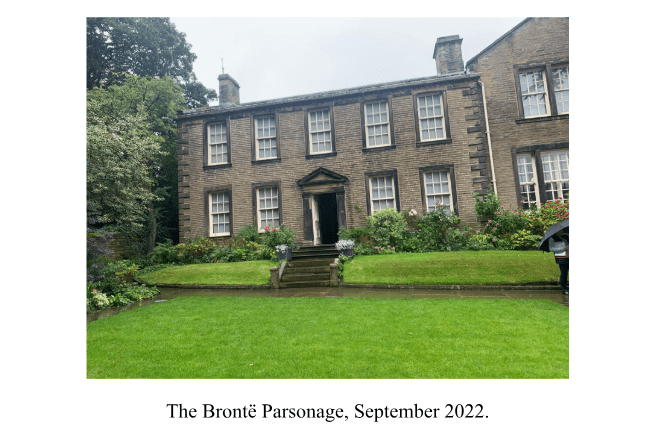
I’m stood outside the Haworth Parsonage where I’m inhaling the fresh Yorkshire air with my eyes calmly shut. I can hear rain patter against the front steps, but the droplets feel cold against my palms and wet beneath the fingertips. Outside of muffled chatter, I hear the wind brushing against the trees as I slowly release my eyelids. I should enter soon, having witnessed enough time pass for the sun to shine and hide behind darkened clouds. Sun showers are a phenomenon by itself, don’t you think? The wind has now picked up, blowing loose leaves to the front doorstep.
As I blink through the rain, I see nine proportionate sashed windows line the exterior with the recent addition of a two-storey gabled wing attached to the right side, which was built seventeen years after Charlotte Brontë’s father died. If I ask a child to draw a house, this is the result; they might include a blue sky with a golden sun against the backdrop. Only, that’s not what the Brontë children would draw, as the fixed image of overcast skies had etched itself into their memories, paired with a bleak reminder of the uninviting churchyard opposite; a deathbed for life. Here, they’d wake up to the sight of arched stones that are immobile, crooked against the earth and weather-beaten from the passing of seasons.
Shrubbery surrounds the entire perimeter and encloses the space from any outsiders. A time existed when it was open and completely rural, but it’s fitting that the Georgian architecture could also be symptomatic of the father, Patrick Brontë’s exactness but strict adherence to custom. The moorland beyond the building had a helping hand into the construction of the Parsonage, as the church used millstone grit to form the initial brickwork.
As you are probably aware, Charlotte, Emily, and Anne spent much of their time outside on the cragged moorland, playing with their toy soldiers and exploring an imagined world at their own leisure. Deep into the Haworth Moor, there is an idyllic tourist attraction dedicated to one of these walks, called the Brontë Falls; a six mile circular excursion starting from St Michael and All Angels uninviting church graveyard. In Elizabeth Gaskill’s life biography on Charlotte, she describes Patrick as ‘strange’, and ‘half-mad’. I wonder what his children thought of him as they got older? Time to find out.
The Hallway
A guide checks my ticket and I’m in. A spotless entrance hall greets my arrival, paired with a stairwell at the far end, but I pause to soak in the simplicity of it all. I’m half-expecting to hear footsteps descend down the stairs at the far end, but I’m taken aback by the state of the wallpaper around the hallway. It’s decorated in a stark pale-blue, which wouldn’t be too far wrong from the original colour scheme back in 1833, accounted by Charlotte’s friend.
Ellen Nussey mentions the walls were ‘not papered, but stained in a pretty dove-coloured tint.’ I’m referring from a guide titled Brontë Parsonage Museum to soak in my surroundings, but provide clarity to what I’m actually seeing in the footsteps of Elizabeth Gaskell and Ellen. The tiled floor would have seen a fair share of sandstone scrubbing duty, as the abrasive texture is effective in targeting dirt, combined with a porous quality that absorbs spilt liquid. I probably won’t touch that.
Trailing along, I can sense the rich and musty smell of wood creeping around the house. The walls are rough to the touch as I run my hand across it, stopping just before the door to the kitchen. Everywhere I look, I’m reminded the building was occupied by hard people with simple needs.
Charlotte, Emily and Anne each had a tough spirit, which was reflected through the characters in their stories. They spent much time in Haworth, although I must digress here, as one of them was considered ‘less’ normal; but they were still strange people. Emily preferred a reclusive and solitary existence away from strangers, but such a character as hers makes you question what inspired her to write Wuthering Heights (1847). Do you believe someone broke her heart?
As the thought crosses my mind, I run my fingers along the slender staircase handrail and look down at the wide stone steps. I put one foot forward and remain there for at least a minute. I must imagine Branwell and Charlotte running up and down in childhood health, playing and laughing in their mythical land of Angria, as is the case with Emily and Anne in Gondal.
But I can’t. My mind chooses to imagine how it all ended under the oppressive gloom of the Parsonage, where Branwell (31) and Emily (30) both succumbed to tuberculosis and died during the season I’m now visiting their home, but it feels like a morgue. Anne (29) caught it, but died the following May in Scarborough; believing the fresh air may counteract the disease. After all the tragedy, the two survivors were in a walking nightmare and destroyed by grief. Patrick was spared his final daughter, but it cost them each others spirit. Life, unfortunately didn’t stop for them.
I release my hand from the rail and move my foot off the step, as the thought slips off my tongue. “Life never stops,” I say, walking in the direction of the dining room.
The home itself looks as untouched as the exterior is to the world, and to my left I peek into a polished dining room, where I see a portrait of Charlotte hanging above the mantelpiece; commissioned in 1850 by her publisher, George Smith. It’s hauntingly silent everywhere, and I’m fearful Emily may walk out of the kitchen and glare at me for smiling! Then again, it is common belief that the sofa in the family room is where she died, with Charlotte next to her.
The Dining Room
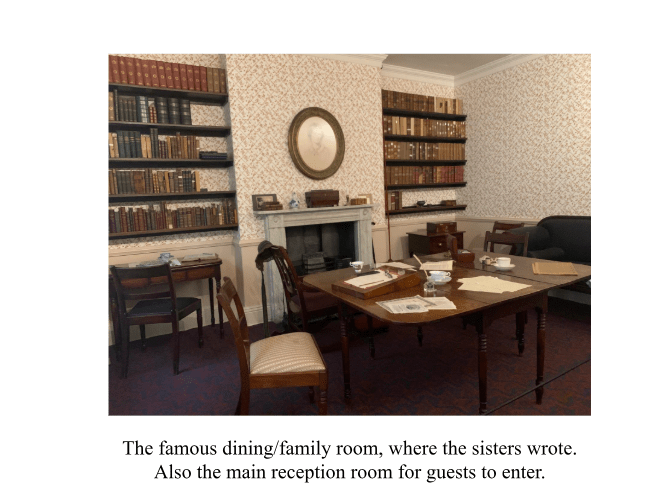
I walk inside the beautifully furnished family space, and pause to admire everything they stood for in life: the writing paraphernalia, the glasses, and even their original mahogany workstation in the centre. This is where the three sisters sat, forming ideas late at night or sharing their own stories, but is ultimately where they penned all of their successful novels that forever exist as literary marvels. Much of the room was altered to fit Charlotte’s designs, but it was papered before and after her changes. All of the furniture on display dates from the period when all three sisters were alive, and I can tell! I can’t get too close to the table as it’s sectioned off from the public, but I can see ink blotch stains, candle burn remains and I’m told there’s even a tiny ‘E’ carved on the wooden surface. It’s her writing space.
Those could be her papers next to that dry pot of ink. I ask a guide. I’m told these are believed to be the contents as Emily left them on the morning of her death in December 1848. Wow.
The Kitchen
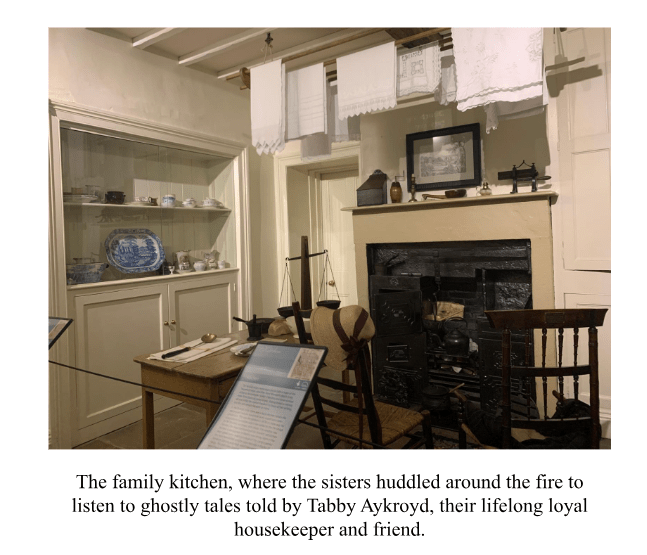
There’s a good chance Emily will torment me in my sleep for encroaching on her space, as she spent much of her time in the kitchen once she volunteered to take on housekeeping duties such as baking the family bread and occasionally doing laundry. Tabitha Aykroyd would gladly have continued to serve them, but in autumn 1836 she slipped in Haworth, critically injuring her leg and being left with a walking impediment for life.
Aunt Branwell made the premature decision to dismiss her, but the young sisters refused to agree to such terms by skipping meals until all had been reversed. Tabby was allowed to stay and if it wasn’t made clear before, know that she was a vital and much loved member of the family.
The kitchen is on the further side of the ground floor and it seems much smaller than I remember when I first visited the Parsonage in August 2017. It’s strange, but upon reading the placard and glancing occasionally at the bonnet hanging on the chair, I’m brought back to my own reality to pause and think about our existence today. The rush, the bustle; to a lack of breathing space when city life consumes every facet of your being.
The Brontë’s appeal to me because the lives they led were simple, spending their whole life outside, thinking, writing and creating rich, fantastical worlds; not doomscrolling for the next quick dopamine fix inside.
I’m sure Emily will walk through the door when I turn my back. It reminds me of a similar experience some years ago at Woolsthorpe Manor, Lincolnshire, when as a child I remember the Flower of Kent apple tree, wondering if I’d catch Isaac Newton sitting there, and then staring back at me for trespassing. In most cases, it’s the charm of the people who inhabited these places that make it a unique and distinct experience for each person.
Mr. Brontë’s Study
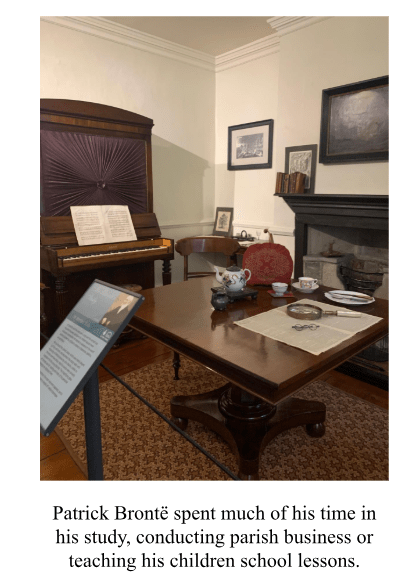
I feast my eyes upon an immaculately arranged room that bears the strong impression of being well-preserved, even before the family passed. The artefacts on display appear well looked after, and I can imagine Reverend Brontë sitting by the fire, perusing through his parish documents. In his old age, he was described as ‘sitting in a plain, uncushioned chair, upright as a soldier.’
Did you know his original name was Brunty? I didn’t, and he had it changed in favour of his hero: Lord Nelson, who had been made the Duke of Brontë after his service during the Napoleonic Wars as a Royal Navy officer. If anything, I’m stunned by Patrick’s stoic countenance, as shown on the placard. It’s hard to imagine if the man ever smiled, and perhaps he governed with an iron-fist. It’s no wonder the children fought earnestly for Tabby to stay.
All of Patrick’s children were well versed in the creative arts, where all of their talent lay. Emily and Anne practised regularly at the cabinet piano, playing with ‘precision and brilliancy’ as described by Ellen. Before his degeneracy into the bottle and needle, Branwell took up painting and writing, but due to his erratic and extroverted personality he was seen as the ‘black sheep’ of the family; unaware of the effect it had on his subdued and introverted sisters. I do wonder how Patrick conducted himself with as much fortitude as he did after the loss of his entire family, even if Branwell probably knocked a few years off him.
The Stairwell Portrait
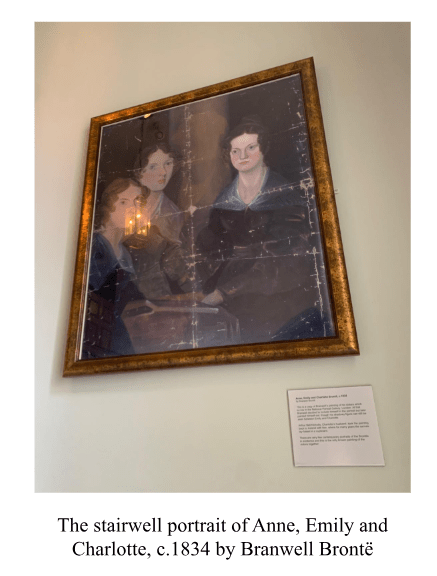
Ah! I’ve found what I’m looking for. It’s not the original, but it’s still the same iconic portrait of the three Brontë Sisters. There are very few in existence, or at least, this is the widely known portrait of them all together. A quick Google search, and wham! Three elusive figures popularly known by Branwell’s exceptional artistic talent. You’d think this portrait would be lying around his studio, cluttered amongst his other drawings. What became of the portrait was a far more complicated affair after the family passed on. So, who remained after Patrick Brontë’s death in 1861?
Well, there was very little keeping Charlotte’s widowed husband, Arthur Bell Nicholls tied to the Parsonage after Patrick’s death. He was the penultimate piece of the puzzle; packing as many mementos and possessions as he could, including this portrait, and the loyalty of Martha Brown, (former servant of the Brontë family) back to Ireland, knowing it was time to move forward.
However, in the end it was Martha who carried the weight of all the losses; having returned to Haworth the following year (1862) to live out the rest of her life among the moors.
References
The Brontë Society (2019) Brontë Parsonage Museum: A guide to the Brontës and their lives at Haworth Parsonage. 1st edn. Haworth, Keighley, West Yorkshire: The Brontë Society.

 Academy of the Heart And Mind